
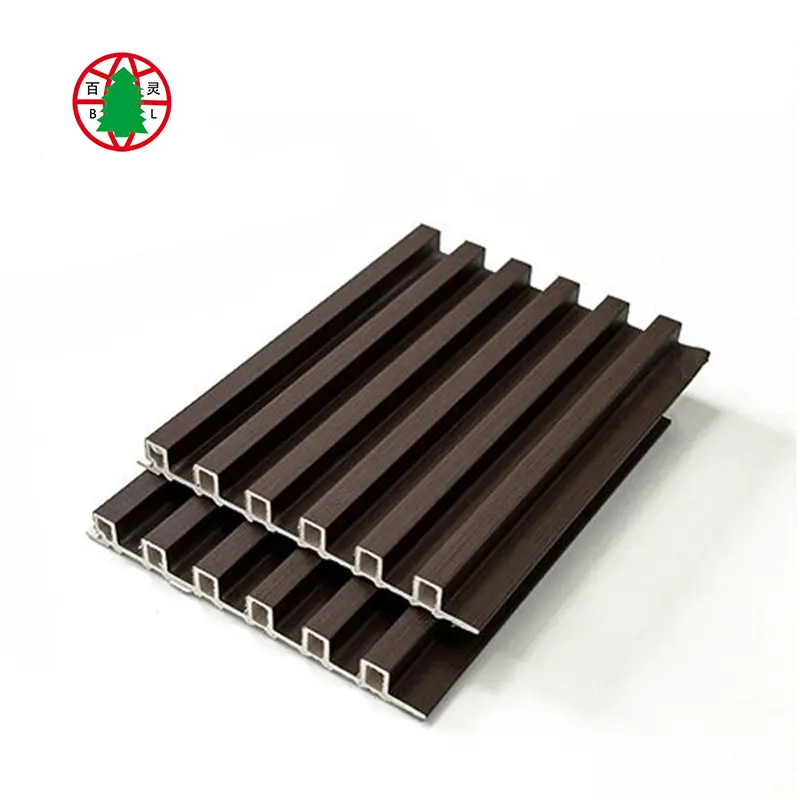
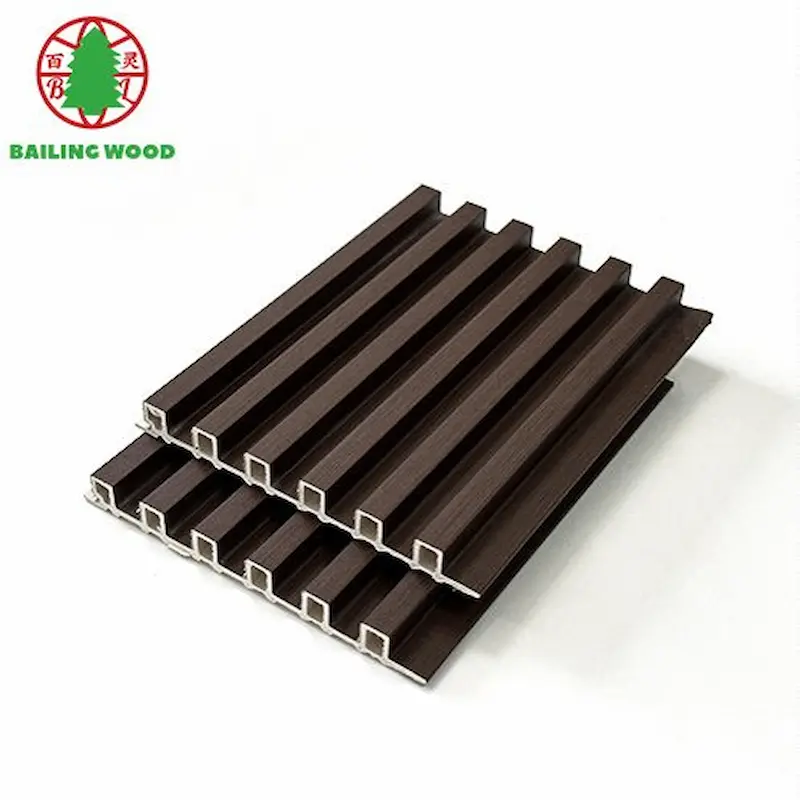
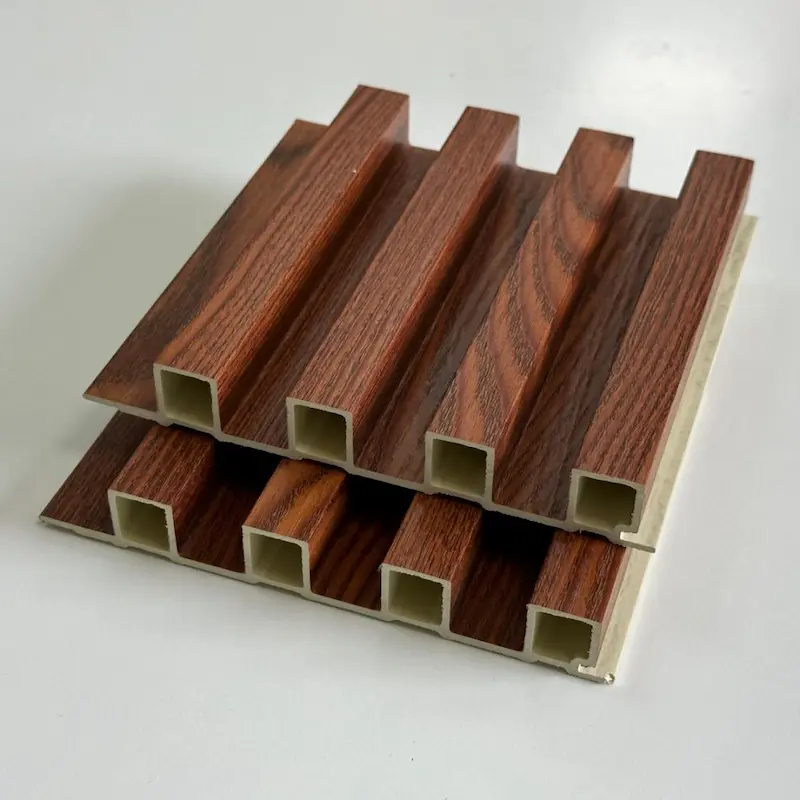
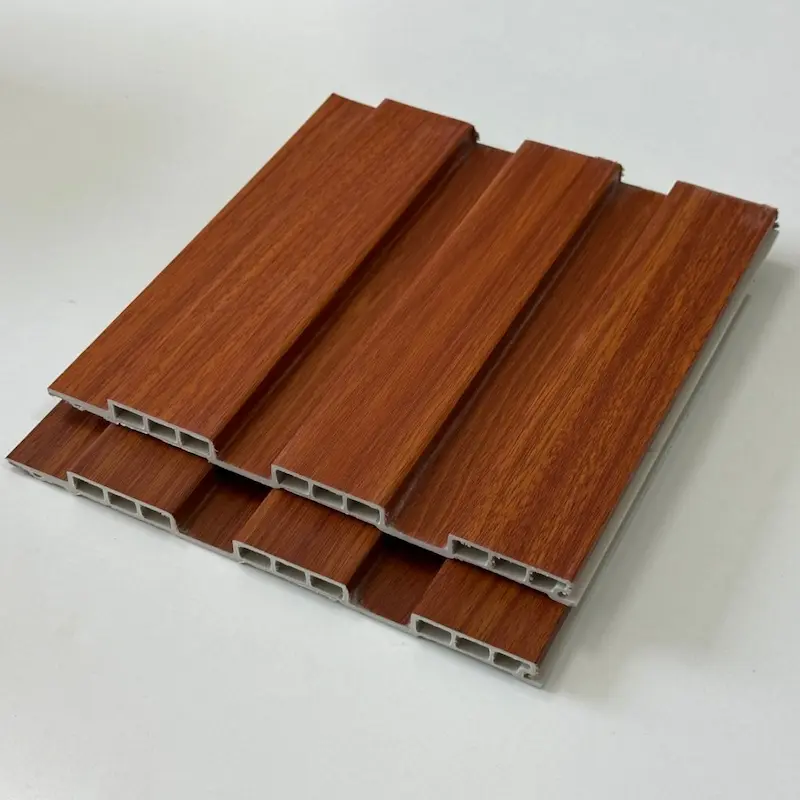
Description
WPC wall panel: exterior cladding that never needs painting
A WPC wall panel is a cladding board made from wood fibre blended with thermoplastic, extruded into a profile and finished with a PVC film face. It brings the appearance of timber cladding to an exterior wall without the maintenance cycle that timber demands: no sanding, no re-oiling, no repainting every few years, and no rot behind the fixing line.
The material is the point. Wood fibre gives the panel its warmth and its ability to accept a woodgrain finish; the polymer matrix makes it waterproof, rot-proof and immune to termites. On a coastal building or a humid climate, that combination is the difference between a facade that still looks new after a decade and one that has been repainted twice.
Technical specification
| Composition | Wood fibre with thermoplastic polymer (WPC) |
| Surface | PVC film coated — smooth or woodgrain texture |
| Format | Extruded profiles; sizes and colours to project |
| Properties | Waterproof, rot resistant, termite proof, low maintenance |
| Maintenance | Wash with water; no painting or sealing |
| Application | Exterior walls, facades, balconies, sheltered interiors |
| Origin | Shouguang, Shandong, China |
Where WPC cladding is used
- Residential facades — feature walls, gable ends and entrance surrounds.
- Office and commercial buildings, where a timber look is wanted without a maintenance contract.
- Balconies, terraces and soffits, including exposed coastal positions.
- Hotel and resort exteriors, where appearance has to survive a tropical climate.
- Exterior ceilings and carport soffits, where a panel must not sag or rot.
What it is not
A WPC panel is not structural and does not replace timber framing. It is a cladding skin fixed over a drained and ventilated cavity, and the cavity is not optional — a panel fixed tight to a wall traps moisture behind it, and that moisture has nowhere to go. Batten the wall, ventilate the cavity top and bottom, and let the cladding do its job.
It is also not identical to timber in appearance. The PVC film face replicates a woodgrain convincingly from a few metres away; at close range the repetition of the pattern becomes visible, particularly on a large area where the same print repeats across many boards. Ordering boards from a single production batch reduces the variation between panels but does not add genuine randomness.
Installation notes that decide the result
- Fix to battens, not directly to the wall. A minimum cavity keeps the back of the panel dry and allows any water that gets behind to drain.
- Allow for thermal movement. WPC expands and contracts with temperature significantly more than timber. Profiles are designed with this in mind; fixing them tight, or butting boards hard together, causes buckling.
- Use stainless or coated fixings. In coastal air, mild steel fixings will stain the panel face long before the panel itself fails.
- Detail the openings. Window and door surrounds, corners and tops of walls are where water gets in. Trim profiles exist for each; improvising them is what causes callbacks.
Interior use and matching products
The same material is used indoors for feature walls, reception backdrops and ceiling details, where the waterproof property is useful in spa, pool and bathroom areas. For an interior wall with a marble or stone appearance instead, see UV marble sheet; for the exterior soffit and fascia line, WPC trims are supplied to match the cladding.
Where a genuinely timber facade is required and a maintenance regime is acceptable, timber cladding remains the honest answer — WPC is specified when the client wants the look without the upkeep, and that trade should be made explicitly.
Ordering and delivery
Send the wall area in square metres, profile and colour reference, fixing direction (horizontal or vertical) and destination port through the contact form. Standard MOQ is one 20GP container with 15–20 days production after deposit. Panels are packed in bundles with edge protection; allow 5–10% for cutting waste on openings and corners.
Frequently asked questions
Does WPC cladding fade?
The PVC film face is UV stabilised and holds colour well. Dark colours absorb more heat and are more prone to surface temperature movement; lighter colours are the safer choice in hot climates.
Can it be installed vertically and horizontally?
Yes. Vertical installation sheds water faster and is standard for facades; horizontal installation needs the profile’s drainage detail to be followed properly.
How long does it last?
Service life depends on climate and fixing detail, but the material does not rot, corrode or feed insects, which removes the main causes of cladding failure. The fixings and the cavity detail are what determine how long the installation lasts.
Can it be repaired?
Individual boards can be replaced by working back from the end of a run. Deep scratches in the film cannot be polished out.
Requesting a quotation
Send area, profile, colour and destination port through the contact form. The full WPC wall panel range covers the profiles available, and WPC doors use the same material for matching openings.
Reviews
There are no reviews yet.