


Description
Block board: solid timber core, panel weight, no sag
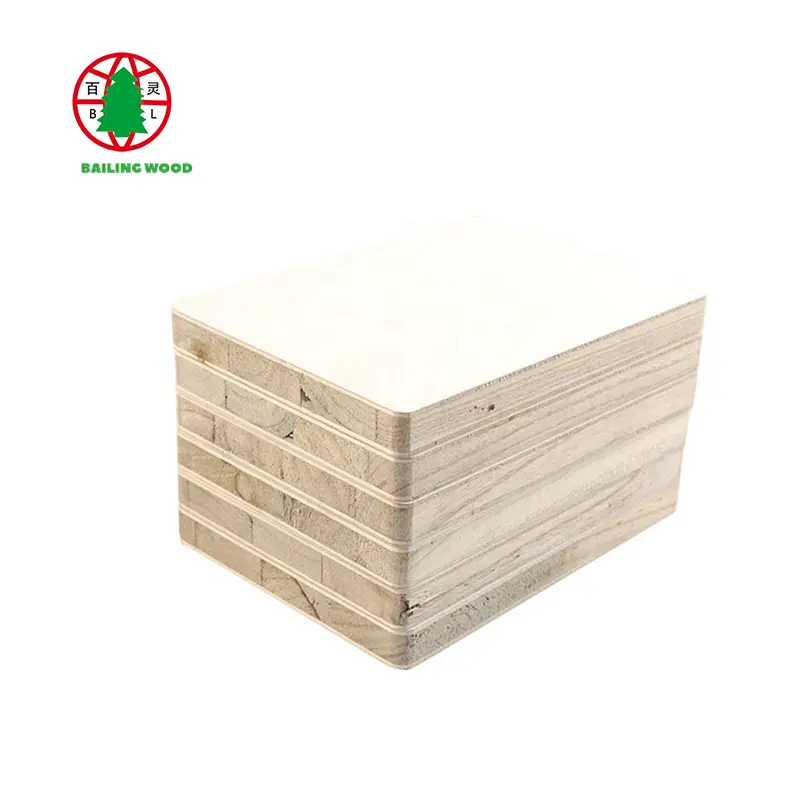
Block board is a sandwich: a core of solid softwood strips laid edge to edge, glued, then faced on both sides with veneer and pressed. The result sits between solid timber and plywood — light enough to hang on a cabinet hinge, stiff enough to span a metre of shelving without a support, and stable enough not to move with the seasons the way solid timber does.
The core is what makes it. Strips are finger-jointed and kiln dried to 8–12% moisture before assembly, then laid with the grain running lengthwise and glued under pressure. That construction is why a block board shelf holds its line over a long span while an MDF shelf of the same thickness creeps, and why a wardrobe door made from it does not twist.
Technical specification
| Panel size | 1220 × 2440 mm |
| Thickness | 16, 17, 18 mm; 15 and 25 mm also produced |
| Core | Solid softwood strips — poplar or pine, edge-glued and finger-jointed |
| Core moisture | Kiln dried to 8 – 12% before assembly |
| Face and back | Hardwood veneer — okoume, bintangor, pine or ash |
| Adhesive | E0 / E1 / E2 urea-formaldehyde; MR for humid climates |
| Surface | Sanded, ready for paint, laminate or further veneer |
| Origin | Shouguang, Shandong, China |
Where block board is the specified panel
- Wardrobe doors and end panels — the classic application. The solid core carries a hinge and stays flat on a 2.2 m door.
- Shelving over long spans. Where a 25 mm MDF shelf sags, block board holds its line.
- Table tops and counter substrates under laminate or veneer.
- Door blanks for flush doors, cut to leaf size and lipped.
- Partitions and wall cladding in hotel and apartment fit-out.
- Built-in furniture where weight matters because the unit is fixed to a stud wall.
Block board against MDF and plywood
The honest comparison: MDF gives a finer, denser surface and machines better for routed profiles, but it is heavy and will not hold an edge fixing. Plywood holds fixings and spans well but weighs more for the same thickness because every layer is a full veneer. Block board is the lightest of the three for a given span, which is why it dominates wardrobe doors — a lighter door needs fewer hinges and puts less load on the carcass.
Its weakness is the core itself: a block board edge is softwood strips, so it must be lipped or banded on any exposed edge, and it should not be routed deeply without support. Treated as a panel product rather than a solid timber substitute, it performs exactly as intended.
Lipping and edge treatment
All exposed edges need a solid timber lipping or a banding. Because the core runs lengthwise, cutting across the grain exposes strip ends that will show through a painted finish — lipping solves both the appearance and the moisture problem. For a decorative face that is already finished, see melamine block board; for a natural timber face, veneer faced block board.
Ordering, packing and delivery
Standard MOQ is one 20GP container, production 15–20 days after deposit, 30% deposit and 70% balance against documents. Panels ship on export pallets with corner protection; loading plans are issued with the quotation.
Frequently asked questions
Is block board stronger than plywood?
Not stronger in bending, but lighter for the same stiffness, and it holds screws along the edge extremely well because the core is solid timber rather than thin veneers. For door leaves and long shelves, it is usually the better choice; for structural sheathing, plywood is.
Can block board be used for kitchen cabinets?
Yes, with the moisture-resistant (MR) glue option and all edges lipped. For sink units and areas with sustained humidity, HMR MDF or a WBP-bonded panel is worth considering instead.
Why does the weight matter so much?
A wardrobe door in 18 mm MDF weighs roughly a third more than the same door in block board. Over a 2.2 m run that is the difference between two hinges per door and three, and between a carcass that stays square and one that racks.
How do I stop the edges showing after cutting?
Lip or band every exposed edge. Cut edges of block board are core strips, so they cannot be sanded and painted to a finish the way an MDF edge can.
Requesting a quotation
Send thickness, face veneer preference, quantity and destination port through the contact form. The full block board range covers plain, melamine faced and veneer faced options.
Reviews
There are no reviews yet.