
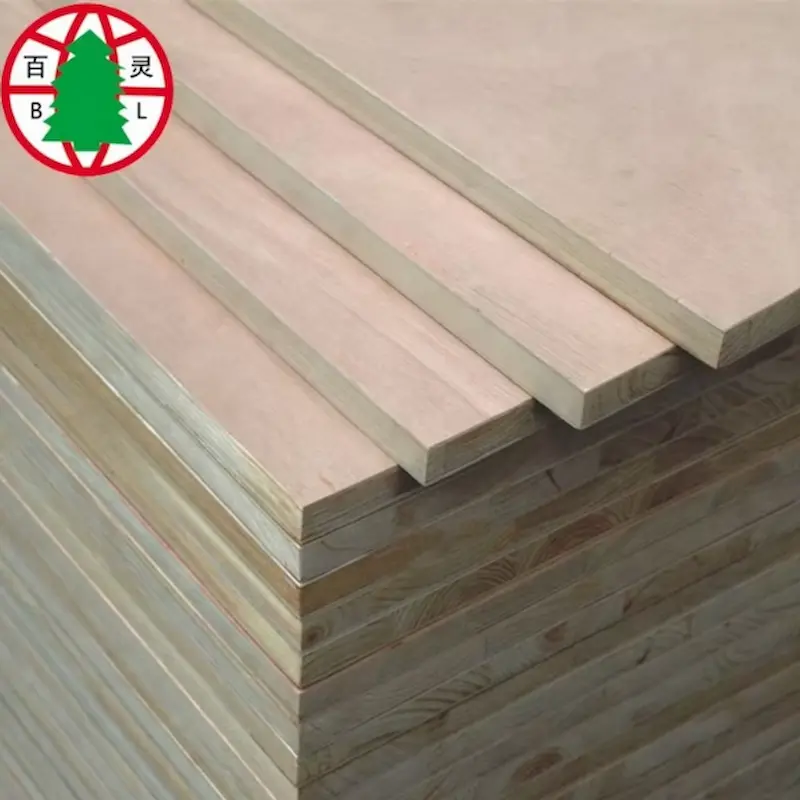
Description
Veneer faced block board: real timber face on a stable core
Veneer faced block board is the panel for projects that want the look of solid timber without the movement of solid timber. The core is edge-glued softwood strips; the faces are sliced natural hardwood veneer — oak, maple, walnut, ash or okoume — bonded under pressure. What you get is a panel that reads as timber, spans like a panel, and stays flat in a way a solid timber door of the same size will not.
The distinction from decorative paper matters. A melamine face prints a woodgrain; a veneer face is wood, with the same variation, figure and depth of grain, and it can be sanded, stained and polished like solid timber. Where the finish will be inspected closely — reception counters, boardroom tables, hotel joinery, high-end residential — that difference is visible at arm’s length.
Technical specification
| Panel size | 1220 × 2440 mm |
| Thickness | 16, 17, 18 mm; 15 and 25 mm on request |
| Core | Solid softwood strips — poplar or pine, finger-jointed, kiln dried to 8–12% |
| Face veneer | Natural hardwood — oak, maple, walnut, ash, okoume, bintangor |
| Adhesive | E0 / E1 / E2; MR for humid service |
| Surface | Sanded veneer, ready for stain, polish or clear lacquer |
| Grain matching | Book-matched or slip-matched to order |
| Origin | Shouguang, Shandong, China |
Where the natural face earns its cost
- Hotel and hospitality joinery — headboards, wardrobes, casegoods and wall panelling where guests see the surface close up.
- Boardroom and dining tables, where a book-matched top is the point of the piece.
- High-end residential doors and panelling in oak, walnut or maple.
- Reception counters and feature walls in corporate fit-out.
- Furniture where the frame is visible and a printed grain would read as a compromise.
Grain matching and sequencing
Natural veneer varies from leaf to leaf and from log to log. Book-matching mirrors adjacent leaves to produce a symmetrical pattern; slip-matching lays them in sequence for a repeating figure. Which one is right depends on the design, and either way the panels must be cut in sequence from the same bundle — mixing bundles in one elevation is the most common reason a veneered wall looks wrong when it is finished.
For that reason we recommend confirming the veneer species, cut (flat, quarter or rotary) and matching method at order stage, and keeping the panels for a single room from a single production batch.
Working with a veneered face
Cut with sharp tooling and always keep a sacrificial support under the exit side of the blade — veneer chips at the cut far more readily than melamine. Edges should be lipped with solid timber of the same species rather than banded, so that the edge and face take stain and polish identically.
Finishing: sand lightly with the grain, stain if required, then seal and lacquer. Because the core is softwood strips and the face is a thin hardwood leaf, aggressive sanding at the edge will cut through the veneer — an unrecoverable error, and the reason pieces should be sanded before assembly rather than after.
If the budget or the wear expectation points to a printed face, melamine block board gives the same core with a decorative paper surface. For an unfinished face to be painted on site, plain block board is the cheaper route.
Ordering, packing and delivery
Standard MOQ is one 20GP container with 15–20 days production after deposit, 30% deposit and 70% balance against documents. Veneered panels are packed face to face with interleaving and corner protection to prevent surface damage in transit.
Frequently asked questions
Is veneer faced block board the same as plywood with a veneer face?
No. The core differs: block board uses solid timber strips, plywood uses cross-laminated veneers. Block board is lighter and holds edge fixings better; plywood is stronger in bending and more dimensionally uniform.
Can the veneer be sanded if it gets scratched?
Lightly, yes — but the veneer is thin, so sanding is limited. Deep scratches that reach the core cannot be repaired invisibly; the panel would need replacing. Protect faces until handover.
Which species are available?
Oak, maple, walnut, ash, okoume and bintangor are the usual range, with others available to order. Send the species and finish reference with the enquiry.
Do you supply matching edge lipping?
Yes — lipping in the same species can be supplied with the order so the edge and face finish consistently.
Requesting a quotation
Send thickness, veneer species and cut, matching method, quantity and destination port through the contact form. The full block board range lists the plain, melamine and veneer faced options side by side.
Reviews
There are no reviews yet.