
Description
OSB: strands, not chips — a structural panel for sheathing and flooring
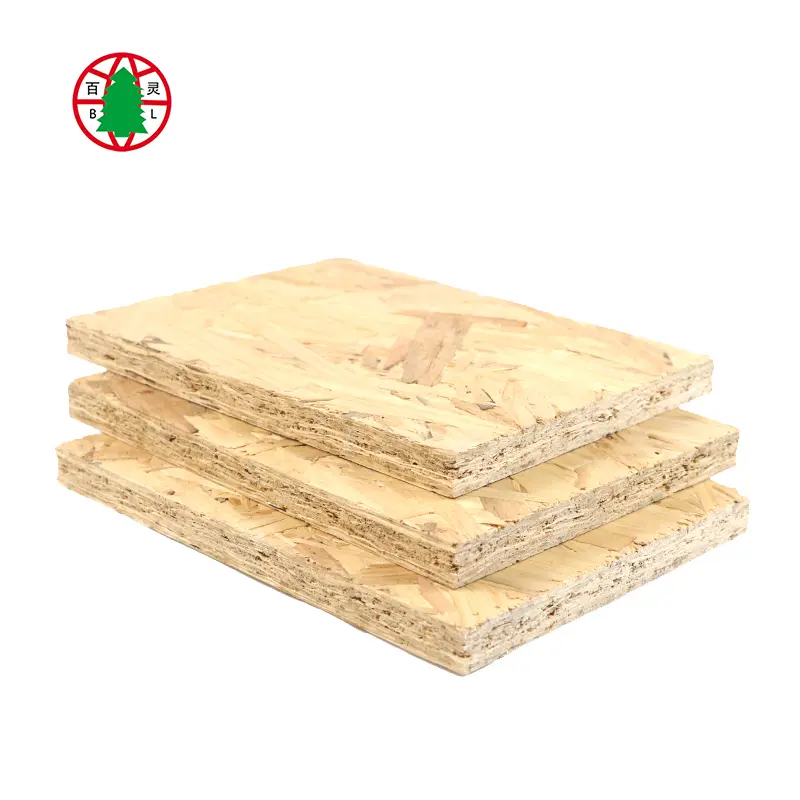
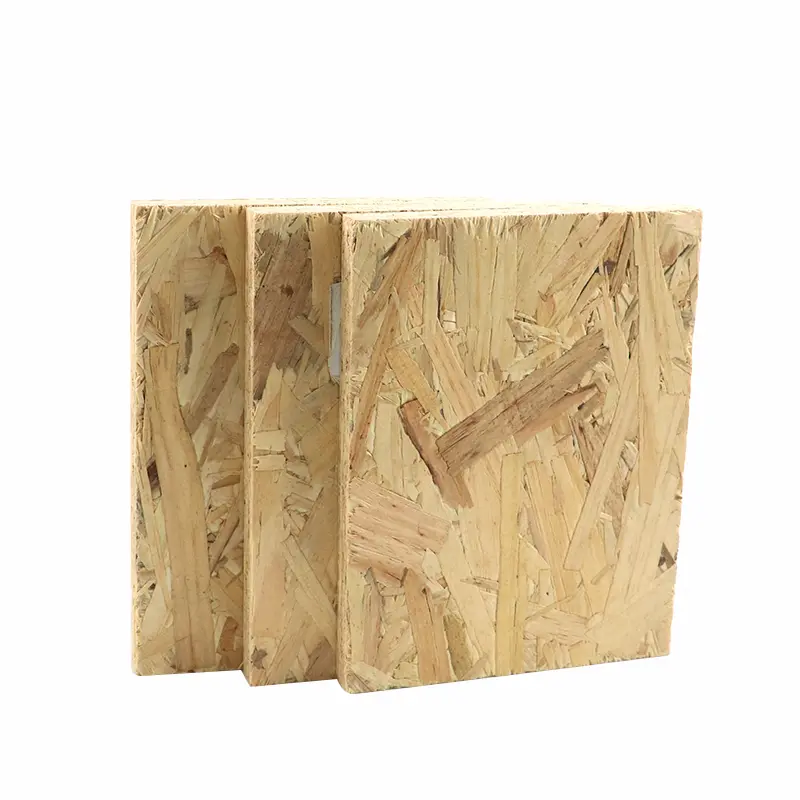
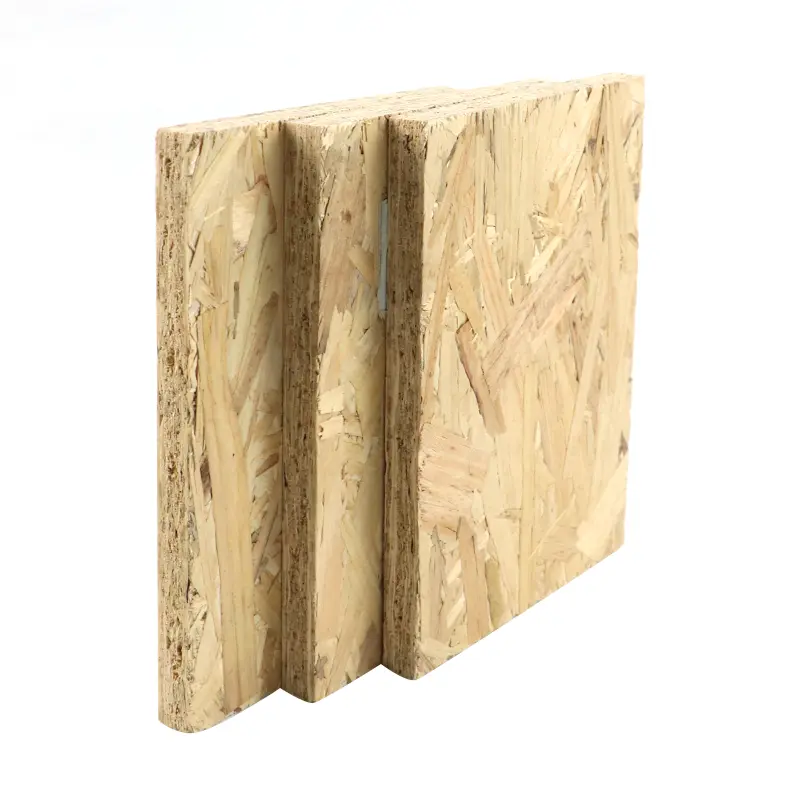
Oriented strand board is often described as an upgraded particle board, and the description is unfair to both. Particle board is made from chips and is a flat panel product. OSB is made from long strands — typically 75–150 mm long, 10–25 mm wide and 0.5–0.7 mm thick — laid in oriented layers and bonded with phenolic or MDI resin under heat and pressure. The surface layers run along the panel length, the core runs across it, and that orientation is what gives the board its structural behaviour.
The result is a panel with mechanical properties close to plywood and load-bearing capacity well beyond conventional particle board, at a cost below plywood of equivalent thickness. That combination is why OSB became the default sheathing board on timber-frame construction worldwide.
Technical specification
| Panel size | 1220 × 2440 mm, 1250 × 2500 mm, 1830 × 2440 mm |
| Thickness | 10 – 25 mm |
| Strand size | 75 – 150 mm long, 10 – 25 mm wide, 0.5 – 0.7 mm thick |
| Structure | Oriented face layers along the length, crosswise core |
| Adhesive | Phenolic (PMDI) or MDI resin |
| Properties | High load capacity, strong screw-holding, resists cracking and warping |
| Origin | Shouguang, Shandong, China |
Where OSB is specified
- Wall and roof sheathing on timber-frame construction, where the panel acts as part of the structural envelope.
- Floor decking — tongue-and-groove OSB is standard over joists in residential build.
- Structural sub-flooring under tile, timber or resilient finishes.
- Site hoarding, formwork backing and temporary works.
- Packaging, crating and industrial pallets, where strength per unit cost decides the specification.
- Furniture frames and structural components that are not visible in the finished piece.
Why orientation does the work
A panel made from randomly scattered strands has similar strength in every direction and fails sooner under bending. OSB’s face strands are aligned with the panel’s long axis, so the board carries bending load the way a beam does, while the crosswise core resists shear between the faces. The same principle as plywood, achieved with strands rather than continuous veneer — which is why OSB can be made from smaller, faster-growing logs and still perform structurally.
MDI and phenolic resins also give OSB its weather tolerance during construction. Panels exposed to rain on site for a period will dry out and recover far better than particle board, though OSB is still not a finished external surface.
Working with OSB
OSB cuts and fixes with standard tools. Screws hold well anywhere in the face — one of its advantages over particle board — and nailed joints perform comparably to plywood sheathing. Two practical notes: the surface is textured and not suitable for a decorative finish without a facing panel, and cut edges are rough, so where an edge is visible it should be trimmed or covered with a scrim and skim.
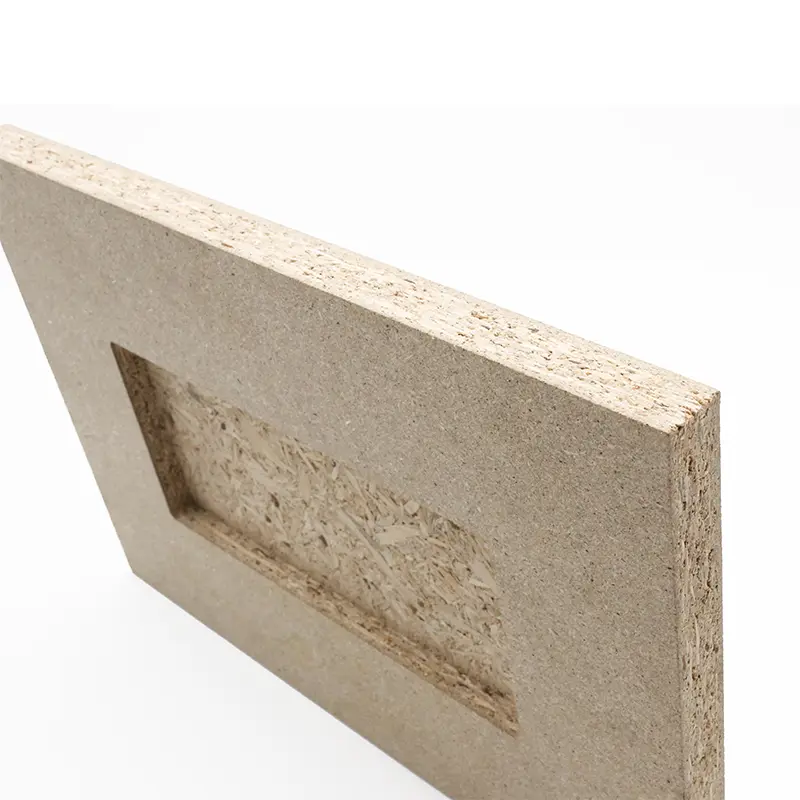
For interior panels that need a smooth decorative face, melamine particle board is the flat-panel option. Where the requirement is a smooth structural panel rather than OSB’s textured surface, commercial plywood or film faced plywood are the alternatives.
Ordering, packing and delivery
Standard MOQ is one 20GP container with 15–20 days production after deposit, 30% deposit and 70% balance against documents. Panels ship in bundles with edge protection; tell us the intended use (sheathing, flooring, furniture frame) so the grade and thickness can be matched to the structural requirement.
Frequently asked questions
Is OSB stronger than plywood?
Comparable for sheathing purposes, and in some ratings OSB exceeds plywood in shear. Plywood generally performs better where the panel must resist repeated wetting or where a smooth face is needed.
Can OSB be used outdoors?
It tolerates weather during construction far better than particle board, and phenolic-bonded OSB can be used in sheltered exterior applications. It is not a finished weather surface — for exposed work, film faced plywood is the correct product.
Why is OSB cheaper than plywood?
It is made from strands of fast-growing small-diameter logs rather than large veneer-grade logs, so the raw material is cheaper and the process uses more of each log.
Can OSB be painted?
It can, but the textured surface shows through and the edges are difficult to finish. For a painted surface, use MDF or a faced panel over the OSB.
Requesting a quotation
Send thickness, panel size, quantity, destination port and the intended structural use through the contact form. The full particle board range covers flat panel, hollow core and OSB.
Reviews
There are no reviews yet.